
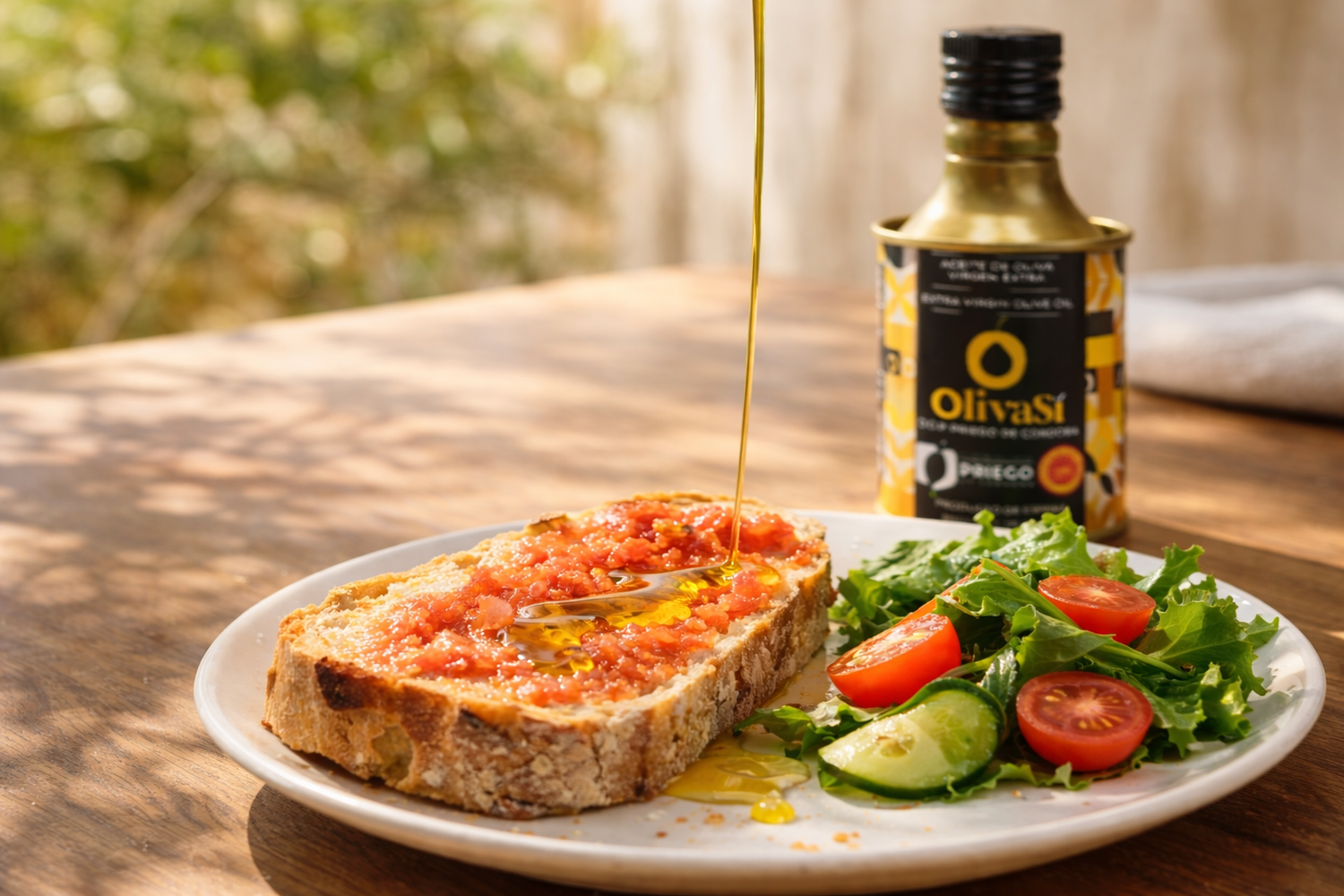
Extra virgin olive oil and weight control: what is the relationship?
When we talk about extra virgin olive oil, we're not just talking about flavor, perfectly finished toast, or a salad that's elevated to another level. We're talking about a food that makes a lot of sense within a healthy diet, and one of the reasons is its relationship with inflammation and general well-being.
The anti-inflammatory properties of extra virgin olive oil are increasingly interesting because they connect with two very real concerns: eating better and feeling better. And EVOO has a lot to say about that. Not because it's a miracle product or because it works magic on its own, but because its composition makes it one of the most interesting fats in the Mediterranean diet. Oleic acid, polyphenols, and compounds like oleocanthal explain a good part of that interest.
Why is extra virgin olive oil linked to inflammation?
The key is understanding that not all olive oil is created equal. Extra virgin olive oil is obtained only by mechanical means and retains natural compounds that are reduced or directly lost in refined oils. These include the antioxidants and polyphenols that give EVOO a much more complete profile than that of a simple cooking fat.
One of the names that comes up most often when discussing this topic is oleocanthal. It is one of those compounds that helps explain why extra virgin olive oil is associated with an anti-inflammatory effect and why some quality oils leave that slight burning sensation in the throat. This touch is not a defect: often it is precisely the sign that you are dealing with a lively EVOO, rich in interesting compounds.
Put simply: the value of EVOO is not just that it is a healthy fat, but that it provides much more than calories. And that changes the rules of the game significantly when compared to less interesting fats or highly processed products.
Key benefits often highlighted
Extra virgin olive oil fits especially well into a wellness-oriented diet because it improves the overall quality of the diet. It's not just about "removing one fat and adding another," but about introducing a food that adds flavor, satiety, and nutritional value at the same time. This practical approach is important, because often the best diet is not the strictest, but the one you can actually maintain.
The most interesting points are usually these:
-
provides quality monounsaturated fats,
-
retains natural polyphenols and antioxidants,
-
helps add more flavor to simple meals,
-
and replaces less recommendable options in daily life.
In real life, this means something very simple: vegetables with good EVOO are more appealing, well-made toast is more filling, and a salad no longer feels like a punishment. And when eating healthy becomes easier and tastier, maintaining the habit also becomes much easier.
Extra virgin olive oil and weight control
This point needs to be explained carefully, because this is where many articles go overboard. EVOO does not cause weight loss on its own. It is not a fat burner, and it makes no sense to market it as such. But it can fit perfectly into a weight control diet for a very simple reason: it helps you eat better.
Although it is a caloric food, it also provides satiety, enhances the flavor of healthy dishes, and allows for more satisfying meals. This can make the difference between a diet you abandon after three days and one you can maintain for months. In this sense, extra virgin olive oil does not stand out for "making you lose weight," but for helping to sustain a higher quality diet. Your blog's recent editorial line itself strongly emphasizes this idea of flavor, satiety, and better adherence to healthy habits.
Therefore, in a well-planned weight control strategy, EVOO makes perfect sense. The key is not to use uncontrolled quantities, but to integrate it thoughtfully into a diet rich in vegetables, legumes, quality proteins, and well-constructed simple dishes.
How to include it in your daily diet
There's no need to overcomplicate things here. Extra virgin olive oil works best when it becomes a natural part of your cooking, not when treated as a strange supplement or a passing fad. At Oliva Sí, we see it quite clearly: good EVOO is meant to elevate simple dishes and to make eating well even more worthwhile. This idea also appears in your recipe and everyday use articles.
You can incorporate it very easily:
-
on breakfast toast,
-
over salads and vegetables,
-
in legume dishes,
-
in fish or creams as a finishing touch.
The important thing is not to find a secret formula, but to give it a permanent place in your daily life. That's where it adds the most value.
How to choose good EVOO
If we want to talk about the anti-inflammatory properties of olive oil meaningfully, we also need to talk about quality. Not all oils play in the same league. It's advisable to look for "extra virgin" clearly stated, to ensure it's well-preserved, and that the brand offers traceability and some information about its origin, format, and product care. Your blog also reiterates this idea: look at the label, origin, packaging, and how it will be used in the kitchen.
Furthermore, there's a rather useful clue: a slight bitterness or a pleasant pungency often accompanies an oil richer in phenolic compounds. There's no need to get technical, but it's important to understand that an EVOO with personality usually has much more to offer than a flat, characterless one.
Conclusion
The anti-inflammatory properties of extra virgin olive oil make sense when understood within a healthy and realistic diet. EVOO provides quality fats, bioactive compounds, and a very practical value: it makes healthy eating easier without sacrificing flavor.
And that, in the end, is what matters. We're not talking about a miracle product, but about a food with a long history within a wellness and weight control strategy. Well-chosen and well-used, extra virgin olive oil not only improves your dishes: it also improves the quality of your diet.