
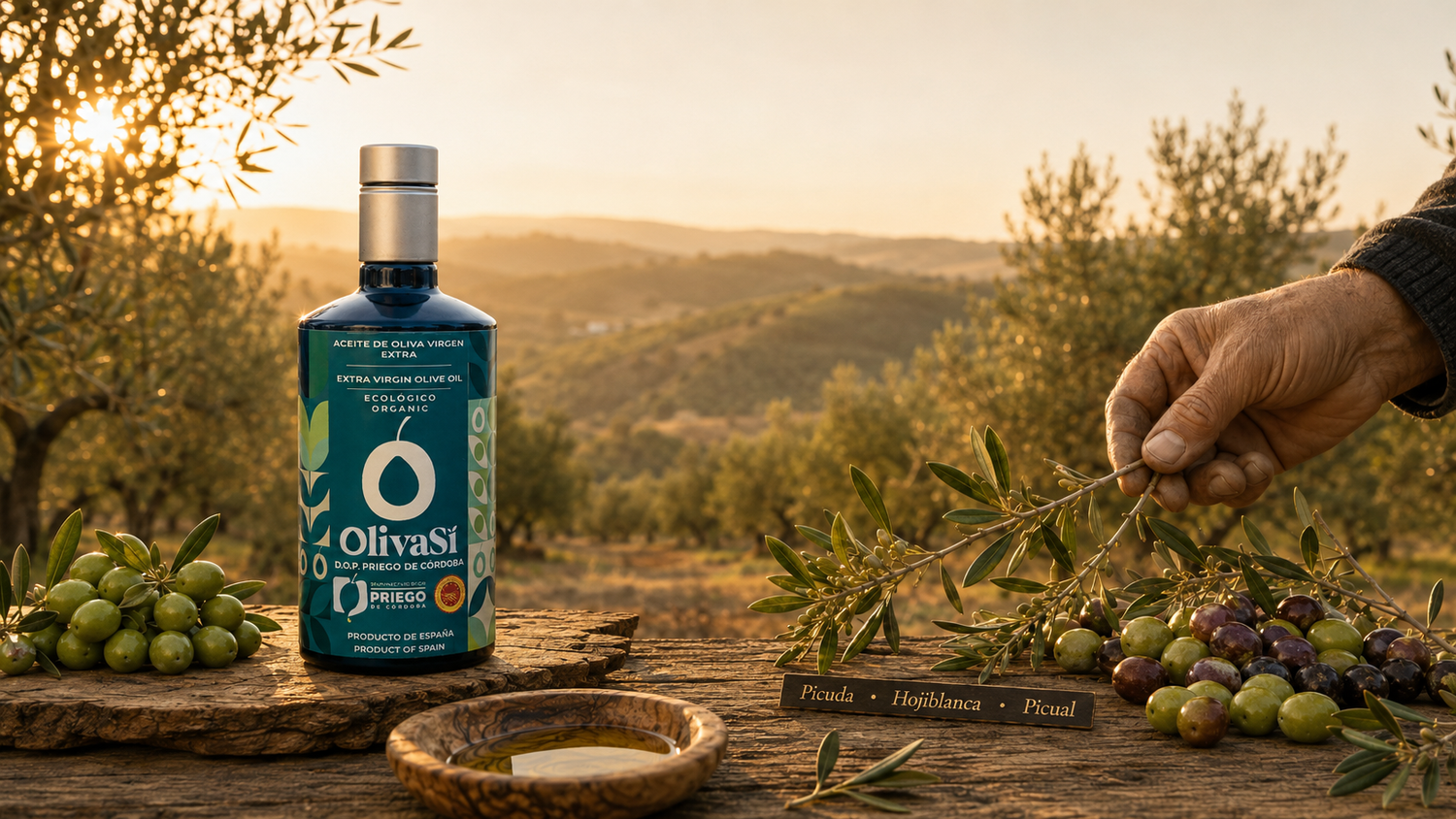
Discover why olive variety and harvest time change the aroma, flavor, and intensity of EVOO
Two extra virgin olive oils can belong to the same category and still offer very different aromas and flavors. One of the main reasons for this is the olive variety and the moment it is harvested.
The variety provides the oil's fundamental personality, while the harvest determines how it expresses itself: greener, more intense, sweeter, or more mature.
The key idea: variety defines character, and harvest sets the style
A simple way to understand it is this:
-
Variety provides the oil's identity.
-
The harvest time modifies its intensity, aroma, and flavor.
-
Processing and preservation help maintain that quality.
That's why the same variety can produce different oils if harvested green, at veraison, or when more mature.
What the olive variety contributes to EVOO
Variety influences aspects such as:
-
The type of fruitiness.
-
Aromatic intensity.
-
The balance between bitterness and pungency.
-
Mouthfeel.
-
Oil stability.
-
Its gastronomic personality.
For this reason, not all EVOOs taste the same, even if they are all extra virgin.
Picuda, Hojiblanca, and Picual: varieties with their own identity
In the D.O.P. Priego de Córdoba, the Picuda, Hojiblanca, and Picual varieties stand out.
Generally:
-
Picuda: usually provides balance, elegance, and fruity notes.
-
Hojiblanca: can offer vegetal and fruity profiles, with variable bitterness and pungency.
-
Picual: usually presents greater intensity and character.
These descriptions are indicative, because the final result also depends on ripeness, climate, plot, and processing.
What changes according to the harvest time
During olive ripening, the following change:
-
The color and texture of the fruit.
-
The amount of oil.
-
The aromas.
-
Bitterness and pungency.
-
The yield obtained at the mill.
Choosing when to harvest is not just about waiting for the olive to have more oil. It's about finding the best balance between quality, yield, and sensory style.
Green, veraison, or ripe olives
Green olives: usually offer more vegetal, intense, bitter, and pungent oils.
Veraison olives: begin to change color and can provide a balance between intensity and smoothness.
Ripe olives: usually offer sweeter, rounder, and smoother profiles, with higher oil yield.
There is no single perfect moment. It depends on the variety, the region, and the type of oil desired.
What early harvest contributes
Early harvest is usually carried out when the olive is green or beginning veraison.
It can contribute:
-
Greener and fresher aromas.
-
Greater fruit intensity.
-
More present bitterness and pungency.
-
Lower yield per kilogram of olive.
-
A very attractive profile for raw consumption.
However, "early" does not automatically mean "better." The fruit must be at an appropriate point and processed correctly.
What a more mature harvest contributes
As the olive ripens, the yield can increase, and a milder profile may emerge.
Notes such as:
-
Ripe apple.
-
Banana.
-
Almond.
-
Nuts.
-
Sweeter sensations.
A ripe olive can also produce an excellent EVOO if it is healthy and milled quickly.
Quick table: how EVOO can change
|
Factor |
Early harvest |
More mature harvest |
|
Profile |
Green and vegetal |
Sweet and round |
|
Bitterness and pungency |
More present |
Milder |
|
Yield |
Lower |
Higher |
|
Common use |
Raw and finishing |
Cooking and versatile uses |
This table is illustrative. The variety and processing can change the result.
Variety and ripeness work together
Not all early harvest oils taste the same.
An early Picuda does not offer the same profile as an early Picual. The variety provides the base, and ripeness modifies its expression.
Therefore, when buying an EVOO, it's advisable to ask not only if it's an early harvest but also what variety it contains and what profile it aims to offer.
The time between harvest and milling also matters
Choosing the right variety and harvest date is not very useful if the olive remains stored for too long.
To preserve quality, it is important to:
-
Harvest healthy olives.
-
Avoid bruising and fermentation.
-
Transport them correctly.
-
Mill them as soon as possible.
-
Carefully control the processing.
The speed between harvesting and milling can make a big difference.
Is a more intense EVOO always better?
No. Intensity alone does not determine quality.
An EVOO can be intense and balanced, or mild and complex. The important thing is that it has a clean, fruity aroma and no defects.
The best choice will depend on personal taste and the dish.
How to choose an EVOO according to its use
Greener and more intense profiles work very well with:
-
Toast.
-
Tomato.
-
Vegetables.
-
Legumes.
-
Meats.
-
Creams and soups.
Milder and rounder profiles may fit better with:
-
Pastries.
-
Mayonnaises.
-
Mild fish.
-
Everyday cooking.
-
Delicate recipes.
Point of interest: compare two oils of the same variety
To truly notice the influence of the harvest, try two EVOOs of the same variety: one greener and one more mature.
Compare them on bread or boiled potatoes and note:
-
The aroma.
-
The bitterness.
-
The pungency.
-
The intensity.
-
The final mouthfeel.
The difference is usually much clearer when tasting them together.
Frequently asked questions about variety and harvest
What has more influence: the variety or the harvest time?
Both influence. Variety provides the main identity, and harvest modifies its expression.
Does early harvest always produce a more intense oil?
Usually, yes, although it depends on the variety, climate, and processing.
Why is early harvest usually more expensive?
Because green olives usually offer a lower yield, and more fruit is needed to produce the same amount of oil.
Can an oil from mature olives be extra virgin?
Yes. It can be EVOO as long as it meets the chemical and sensory requirements of the category.
What is the difference between green fruitiness and mature fruitiness?
Green fruitiness is reminiscent of grass, leaf, tomato, or green olive. Mature fruitiness can be reminiscent of apple, banana, almond, or nuts.
Is a monovarietal or a coupage better?
Neither is inherently better. Monovarietal shows a single variety; coupage combines several to seek balance and complexity.
Conclusion: each bottle expresses variety, moment, and origin
The variety largely determines the personality of the EVOO, and the harvest time defines how that personality is expressed.
At Oliva Sí, the origin in Priego de Córdoba and the work with varieties linked to its D.O.P. allow us to enjoy oils with distinct profiles, but always connected to the territory, the selection of the fruit, and careful processing.