
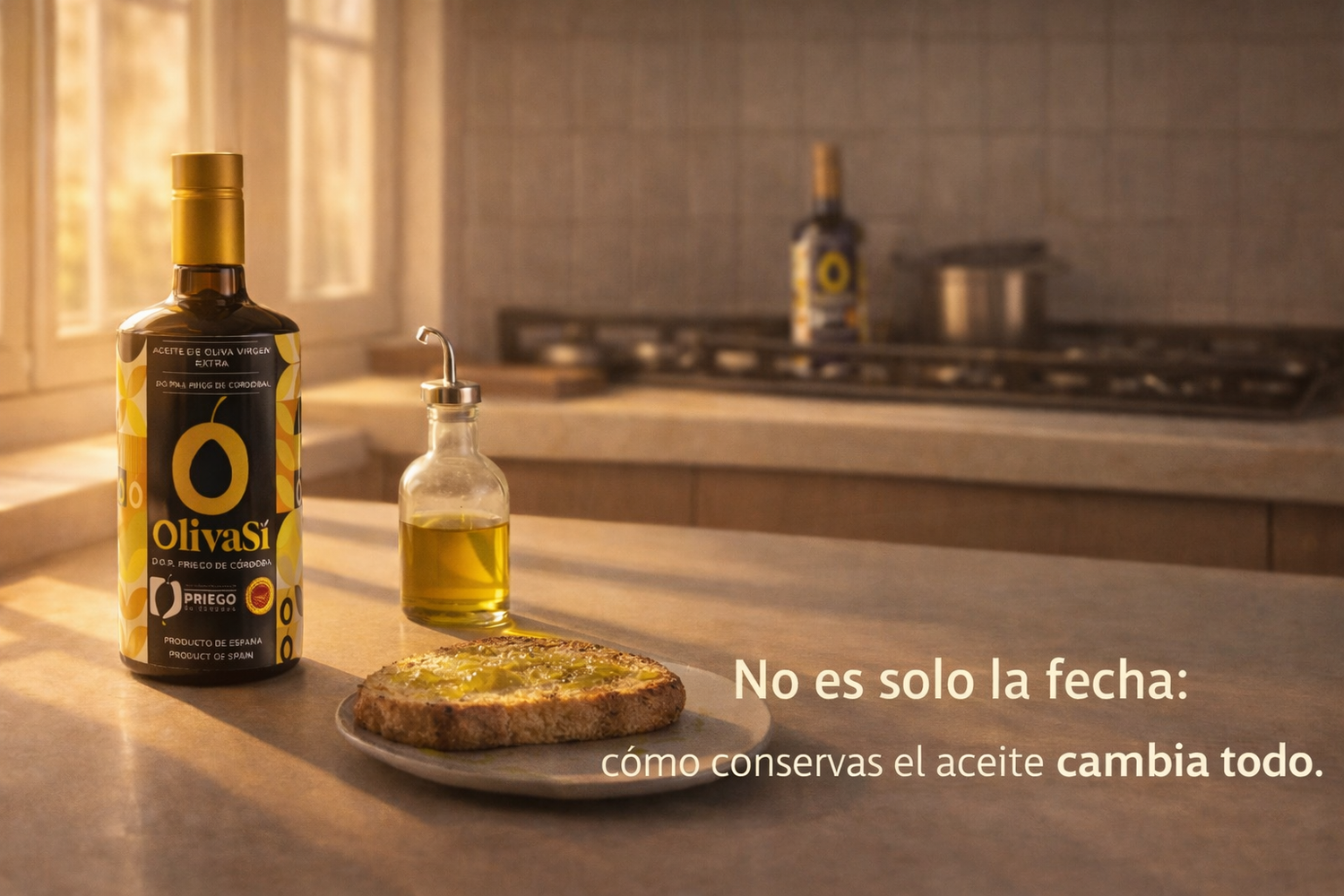
Best before date, signs of deterioration, and how to preserve it better
Many people see the date on the bottle and think that, after that day, olive oil can no longer be used. But it doesn't quite work like that. With oil, it's common to talk about a best-before date, not a strict expiration date like with other highly perishable foods. This means that, after that date, it can still be suitable if it has been stored well, although it probably won't maintain the same aroma, flavor, and quality. AESAN precisely explains this difference between expiration and best-before dates.
Does olive oil expire or not?
The short answer is: it doesn't expire suddenly, but it does lose quality over time. The most important thing is not just the date on the package, but how it has been stored. Well-preserved oil lasts much better than one that has been open for months, near light or heat.
Therefore, when someone asks if olive oil expires, they usually want to know something else: if it's still worth using. And there, the answer depends on its actual condition.
What the best-before date means
The best-before date indicates until when the product maintains its optimal qualities. It does not mean that, the next day, the oil is automatically bad or dangerous. What usually happens is that it gradually loses freshness, intensity, and nuances. AESAN points out that, after that date, the food can still be safe if it has been stored correctly and the packaging is intact.
With good olive oil, this matters a lot, because much of its value is in the flavor. When it's fresh, its aromas, balance, and personality are better appreciated. When it ages poorly, it becomes flatter and less pleasant.
How to tell if oil is past its prime
The best way to check is not just to look at the bottle, but to smell and taste it. If the oil smells dull, old, or rancid, that's a bad sign. If, when you taste it, you notice that it has lost its vibrancy, that it's flat or leaves an unpleasant taste, it's no longer at its best.
What usually gives away deteriorated oil is:
-
rancid smell
-
flat or stale taste
-
loss of aroma
-
sensation of "old" oil in the mouth
The color can change a bit over time, but it's not the most reliable clue. What really matters is how it smells and tastes. Olive Oils from Spain also insist that the main enemies of quality are light, heat, and oxygen.
What happens if you use expired olive oil?
In most cases, the main problem is not that it's "forbidden" to consume it, but that it no longer offers the same quality. That is, it may not give you problems, but it won't give you a good experience either, especially if you use it raw.
Toast, salad, or a finished dish with dull oil loses a lot. On the other hand, in cooking where the oil is not as prominent, that loss may be less noticeable. Therefore, if a bottle has lost freshness but is not clearly rancid, it could still be used for cooking. If it smells bad or tastes bad, it's not worth keeping.
How to store olive oil to make it last longer
There are no strange secrets here. For oil to last longer, it must be protected from three things: light, heat, and air. Storing it well makes the difference between oil that remains stable and oil that spoils prematurely. The industry insists on precisely that: storing it in a cool, dry, well-sealed place, away from the hot kitchen, significantly extends its shelf life.
Ideally:
-
store it in a cupboard or dark place
-
keep away from stoves and ovens
-
close the bottle tightly after use
-
don't leave it open for months unchecked
-
buy a reasonable amount to consume at a good pace
Conclusion
So, does olive oil expire? Not in the way many people think, but it can pass its prime. The key is understanding that safety is one thing and quality is another. If the oil has been stored well, it can still be usable after the best-before date. However, if it has lost aroma, freshness, and flavor, it will no longer live up to what you expect from good oil.
At Oliva Sí, we would summarize it like this: if an oil no longer smells good, tastes good, or adds anything, it's not worth showing off.