
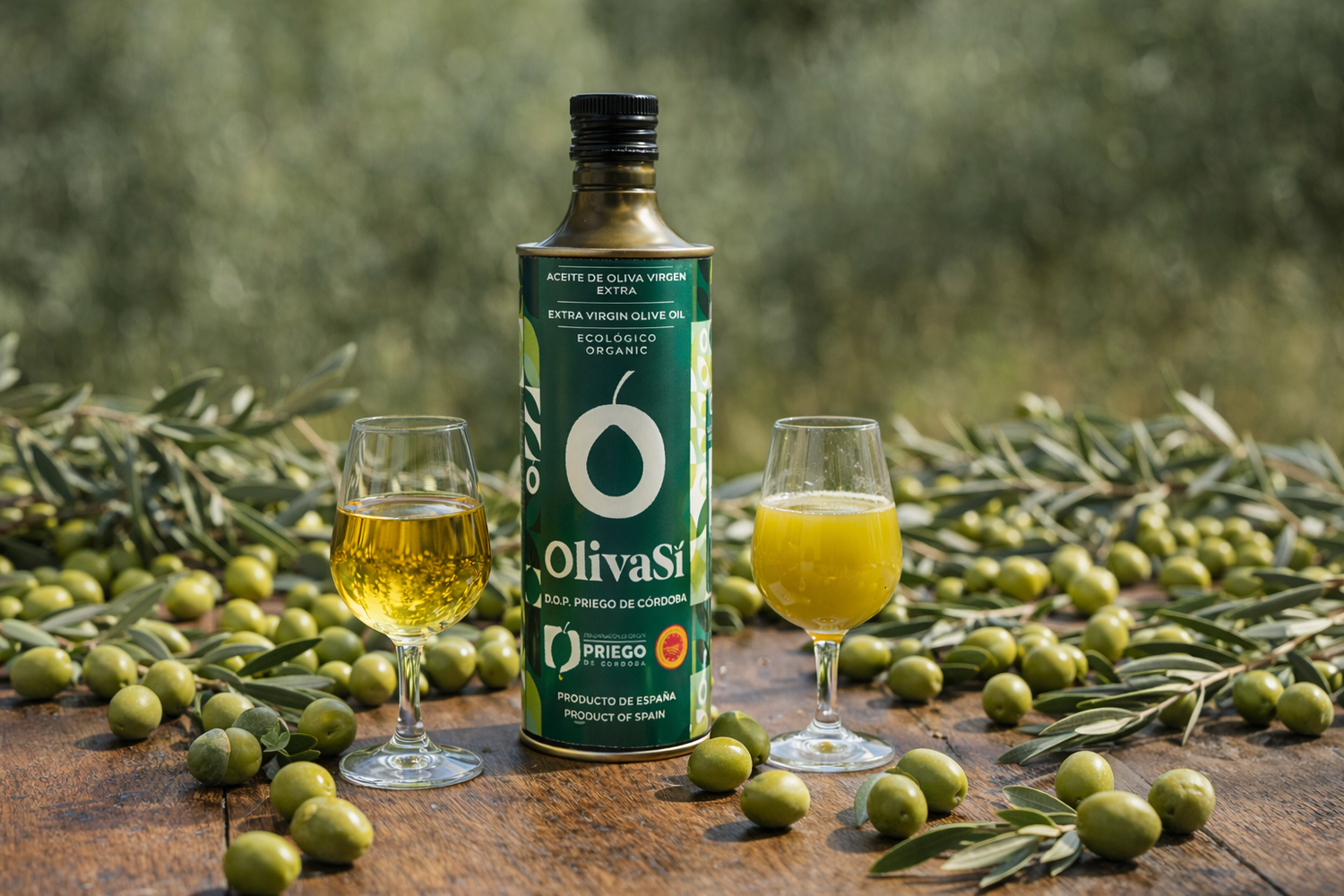
What makes early harvest oil special?
When someone looks for early harvest oil, they almost always want to answer three questions at once: what makes it special, why it usually costs more, and if it's really better than other EVOO. The short answer is that it can offer a more intense, fresh, and complex profile, but it's important to understand what that term means and not confuse it with other ideas that are not exactly the same.
Quick table to avoid confusing concepts
|
Concept |
What it means |
What it does not mean |
|
Early harvest |
Olives picked before full ripening, usually green or whole |
That the oil has to be unfiltered |
|
Green oil |
A greener color, influenced by chlorophylls, variety, ripeness, and fruit conditions. |
That it is automatically better or of higher quality |
|
Unfiltered / "en rama" |
Oil bottled without filtering, with suspended particles and some moisture |
That it is by definition early harvest |
This distinction is key. The sector explains that filtering is a separate phase of the production process and that the color of the oil is not directly related to its quality; therefore, an early harvest EVOO can be filtered or unfiltered, and a greener oil is not necessarily better just because it looks greener. This is a solid inference based on how the filtering process is described and the role of color by sector sources, and how Oliva Sí also explains it in its blog.
What exactly is an early harvest oil?
Early harvest oil is considered to be oil obtained from olives harvested before their full ripeness, usually during veraison, when the fruit begins to change from green to purple, or even a little earlier. There is no universal fixed date, because it depends on the area, the variety, and the climate, but the references consulted place this period, approximately, between October and mid-November. In addition, the term "early harvest" itself is not defined by a specific regulation, but rather functions as a quality stamp assumed by the sector.
This already gives an important clue: early harvest is not about empty marketing when it is well explained, but about a specific agronomic decision. It is harvested earlier, milled quickly, and the sensory expression of the oil is prioritized over maximizing yield per kilo of olives.
Why it is usually so popular: more freshness, more intensity and more character
Early harvest oils usually stand out for a fruitier, herbaceous, fresh, and intense profile, with more marked green notes and a greater presence of bitterness and spiciness when well balanced. Sector sources and competitor pages agree on this idea: these are oils that usually offer more vibrancy, more aroma, and a clearer personality on the palate.
They are also usually associated with a higher concentration of phenolic compounds and natural antioxidants, precisely because the olive is picked at an earlier stage and the oil better retains that lively character. Oliva Sí's own blog emphasizes this relationship between early harvest, intensity, and polyphenols, and Las Valdesas follows the same line when comparing these oils with those made from more mature fruit.
Early harvest is not the same as green oil or unfiltered oil
This is the point where it is most worthwhile to refine the article to make it better than the competition. There are brands that almost automatically associate early harvest with "green oil," and it is true that they often coincide. But they are not exact synonyms. The color is influenced by pigments like chlorophylls, yes, but also by the variety, the ripeness of the fruit, the climate, and the soil. In fact, Aceites de Oliva de España makes it clear that color alone has no relation to quality.
Nor should early harvest be confused with unfiltered oil. Filtering is a subsequent step that is usually repeated before bottling to remove moisture and suspended organic matter. If it is not filtered, we are talking about "en rama" or unfiltered oil. Therefore, an early EVOO can be sold filtered or unfiltered; these are different decisions: one has to do with when you pick the olives and the other with how you stabilize the oil before bottling. Oliva Sí also explains it very well: just because an oil looks cloudier doesn't automatically make it better.
Why it usually costs more
Here we need to be clear, because it is one of the questions that carries the most weight in the purchase decision. Early harvest oil usually costs more because it yields less. Las Valdesas provides quite clear indicative figures: while an EVOO from more mature olives can yield between 20% and 25%, in early harvest the average can be around 12% to 14%. Simply put: more kilos of olives are needed to obtain the same amount of oil.
To this is added a more delicate harvesting, a quick milling and a work focused on preserving aromas, freshness and sensory cleanliness. Origen Oliva, although it does so from a collection page, summarizes it well by relating early harvest with early harvesting, careful processing and lower yield in exchange for greater sensory expression.
How to use it to truly enjoy it
If you buy a good early harvest oil, it makes sense to take advantage of exactly what makes it special. That's why the most repeated recommendations point to its use raw: on toast, in salads, grilled vegetables, carpaccios, cheeses, finished dishes, or mild sauces. These are contexts where the oil can truly express itself and where that green freshness makes a difference.
That doesn't mean you can't cook with it. You can. But, if what you're looking for is to fully enjoy its aromatic profile, it usually shines more as a finishing touch or protagonist when raw than in long preparations where some of its nuances will be attenuated. This practical approach is better resolved in Origen Oliva than in other references, and it's worth keeping it in your article.
How to choose a good early harvest oil without being swayed by the bottle
The best purchase is not made by just looking at the color. It is worth looking at the harvesting campaign, whether cold extraction is mentioned, the protection of the container from light, traceability and, when it exists, seals such as the PDO. All of this helps much more to detect a good EVOO than a nice photo or a greener shade in the glass.
It's also worth remembering that a filtered oil is not worse for being filtered. Many times, precisely because it removes moisture and particles, it is more stable and easier to store at home. This idea, which is already very well explained in Oliva Sí's post about filtering, fits perfectly into this article because it prevents the reader from confusing appearance with real quality.
At Oliva Sí, we summarize it like this
At Oliva Sí, talking about early harvest oil makes sense when the harvest is done seeking the best moment of the fruit, not just a striking oil in the photo. The brand itself already explains it on its blog: they only bottle early harvest oil and present it as part of a commitment to freshness, flavor, cold extraction, and polyphenol content.
And here is the message that can connect most with the reader: a great early EVOO doesn't need to look cloudy to be excellent, nor rely solely on color to impress. What really matters is that it is well made, well preserved, and that, when you taste it, it has that lively, fresh, and expressive point that justifies every drop. That is precisely the ground where a brand like Oliva Sí can sound convincing without exaggerating.
Conclusion
An early harvest oil is an EVOO made from olives harvested before their full ripeness, usually at veraison, seeking more intensity, more freshness, and a more complex profile. It usually costs more because it yields less, and it tends to be more appealing to those who value aroma, balanced bitterness, and that well-executed green note. But there is one idea that needs to be very clear: early harvest does not necessarily mean unfiltered, nor does green automatically mean better.
Therefore, for an Oliva Sí blog, the best approach is not to repeat what everyone says, but to explain it better: with more clarity, with fewer myths, and with more useful criteria for those who are actually going to buy, try, and compare.