
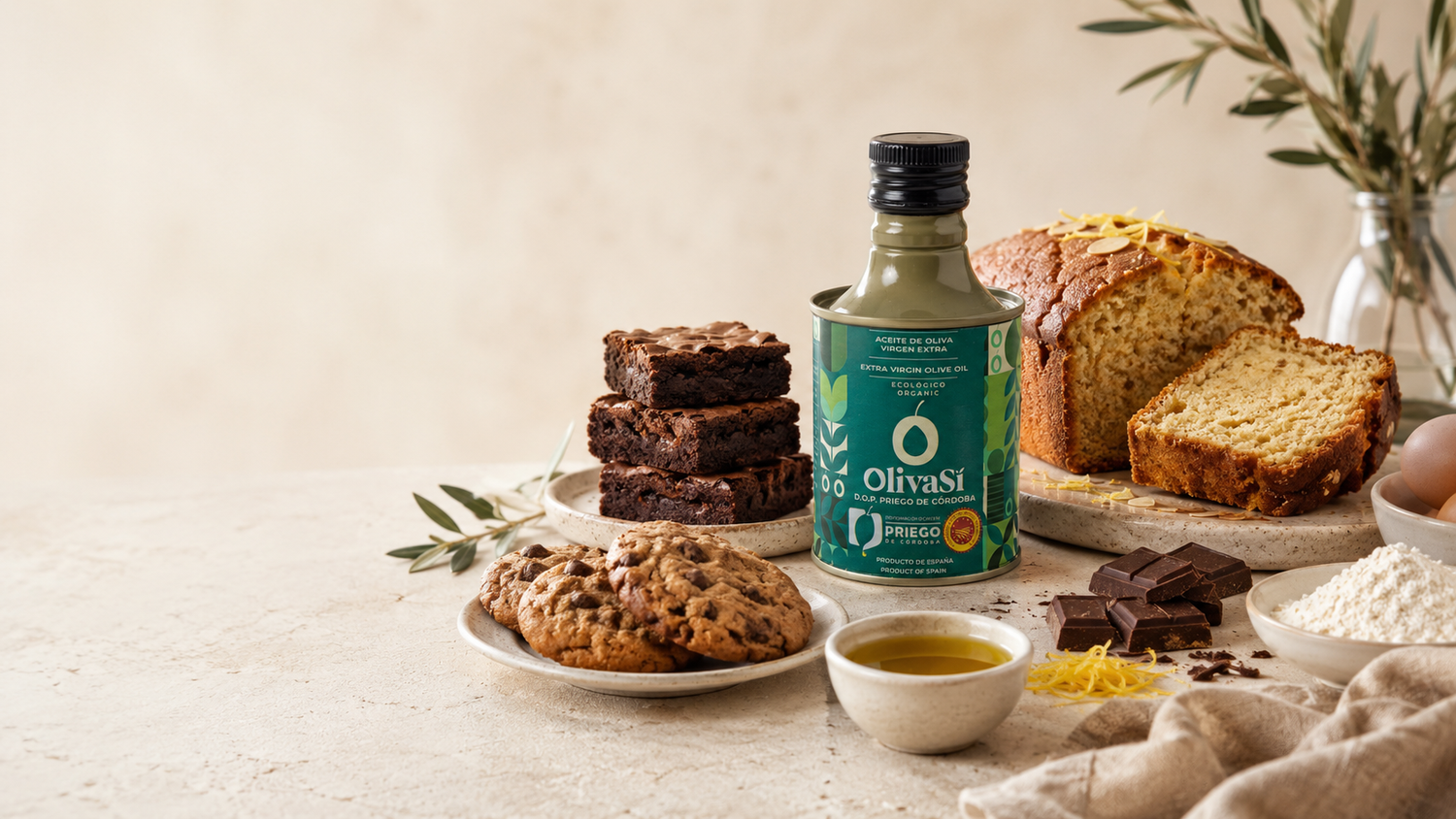
Why more and more people are using EVOO in baking
EVOO makes baked goods more moist and gives them a very pleasant texture, especially in sponge cake and brownie-type batters, where moisture is key. Additionally, it can add an aromatic touch (mild or more pronounced depending on the oil) that pairs perfectly with citrus, vanilla, nuts, or chocolate.
What changes when substituting butter with EVOO (the simple explanation)
Butter is not just fat: it also contains water and milk solids. EVOO, on the other hand, is practically "pure" fat. Practical result:
-
EVOO usually leads to more moistness.
-
Aeration changes (butter "creams" very well with sugar; EVOO does not in the same way).
-
Flavor may vary (from neutral to fruity, depending on the EVOO).
Butter → EVOO equivalency (clear rule and quick table)
The most useful rule you'll see repeated in ranking guides: use less EVOO than butter (because butter contains water and EVOO is more concentrated). A commonly used range is to reduce by 20–25%.
Quick table (easy to apply)
-
100 g butter → 75 ml EVOO
-
50 g butter → 40 ml EVOO
-
1 cup butter (approx.) → ¾ cup EVOO
-
Express rule: butter × 0.75 = EVOO (approx.)
Which EVOO to choose for baking (so it doesn't "overpower" the dessert)
If you're looking for a "sweeter and finer" result, most recommendations lean towards mild and fruity EVOOs, which respect the dessert's flavor profile. Mild varieties like arbequina/hojiblanca usually work well in delicate sweets.
Cakes with EVOO: what changes and how to adjust for a fluffy result
In cakes, EVOO usually results in a very tender and moist texture, and helps prevent them from drying out quickly.
To make it perfect:
-
If your recipe used "creamed" butter (beaten with sugar), change the method: beat eggs + sugar well to incorporate air before adding the EVOO.
-
Maintain the equivalency (≈75% EVOO) and, if the batter is too dense, adjust with a splash of liquid (milk/plant-based drink/juice) in small amounts.
-
EVOO pairs especially well with citrus, vanilla, cinnamon, almond, and chocolate (Mediterranean profile).
Cookies with EVOO: what changes (and the trick to not losing texture)
This is where most people go wrong: in cookies, butter provides structure and "snap" when cooled (due to how it solidifies). With EVOO, you can achieve very delicious cookies, but they tend to:
-
Be somewhat more tender and less "crisp" if you don't adjust.
Tricks that work: -
In "cookie" type recipes, use the 75–80% equivalency and chill the dough for 30–60 minutes before baking.
-
If you want more firmness, using brown sugar or slightly increasing the chilling time (without overdoing it) helps.
-
Choose a mild EVOO if you want the chocolate/vanilla to stand out.
Brownies with EVOO: why it's often the most rewarding change
Brownies specifically aim for fudginess/moistness, and EVOO fits wonderfully there: it maintains moisture and pairs very well with cocoa. Many top resources highlight it as one of the best applications of EVOO in sweet treats.
Quick tips:
-
EVOO + cocoa works particularly well if the oil is mild (to avoid overpowering the chocolate).
-
Watch the baking: a "perfect" brownie will seem slightly undercooked in the center when it comes out; it finishes setting as it cools.
When NOT to substitute butter with EVOO (what almost no one says clearly)
There are recipes where butter is not just fat, but architecture:
-
Puff pastries and laminated doughs like croissants/Danish pastry.
-
Very traditional buttercream or preparations where you need the dairy flavor and exact structure.
In these, you can experiment, but don't expect the same result without adapting the technique.
7 common mistakes when using EVOO in baking (and how to avoid them)
-
Using 1:1 (same amount) and the dessert turns out greasy → use approx. 75–80%.
-
Choosing a very intense EVOO for a delicate cake → a mild EVOO is better.
-
Not beating eggs+sugar enough when you previously "creamed" butter.
-
Not chilling cookie dough → they expand too much.
-
Overbaking brownies/cakes → they dry out (even with EVOO).
-
Storing EVOO near heat/light → it loses freshness and aroma before use.
-
Not tasting the oil on its own: if you don't like it raw, you won't like it in the dessert.
Mini-guide by objective: "I want it to taste like..."
-
Neutral, classic sweet flavor: mild EVOO + vanilla/citrus.
-
Gourmet touch: mild EVOO + dark chocolate + flaky salt (in brownie).
-
Mediterranean: EVOO + orange/lemon + almond.
Frequently asked questions
How much EVOO do I use if the recipe calls for 100g of butter?
As a practical rule, use about 75 ml of EVOO (20–25% reduction).
Does EVOO significantly change the taste of cake?
It depends on the EVOO. With a mild one, the change is slight; with an intense one, it can contribute a greener/fruitier profile.
In which desserts does EVOO work best?
It usually shines in cakes, muffins, and brownies for its moistness.
Can I use EVOO in cookies?
Yes, but they tend to be softer. Chilling the dough and adjusting the proportion helps a lot.
If you want to start successfully, first try a brownie or a lemon cake using a mild EVOO: it's the easiest way to notice the moistness without complications.