
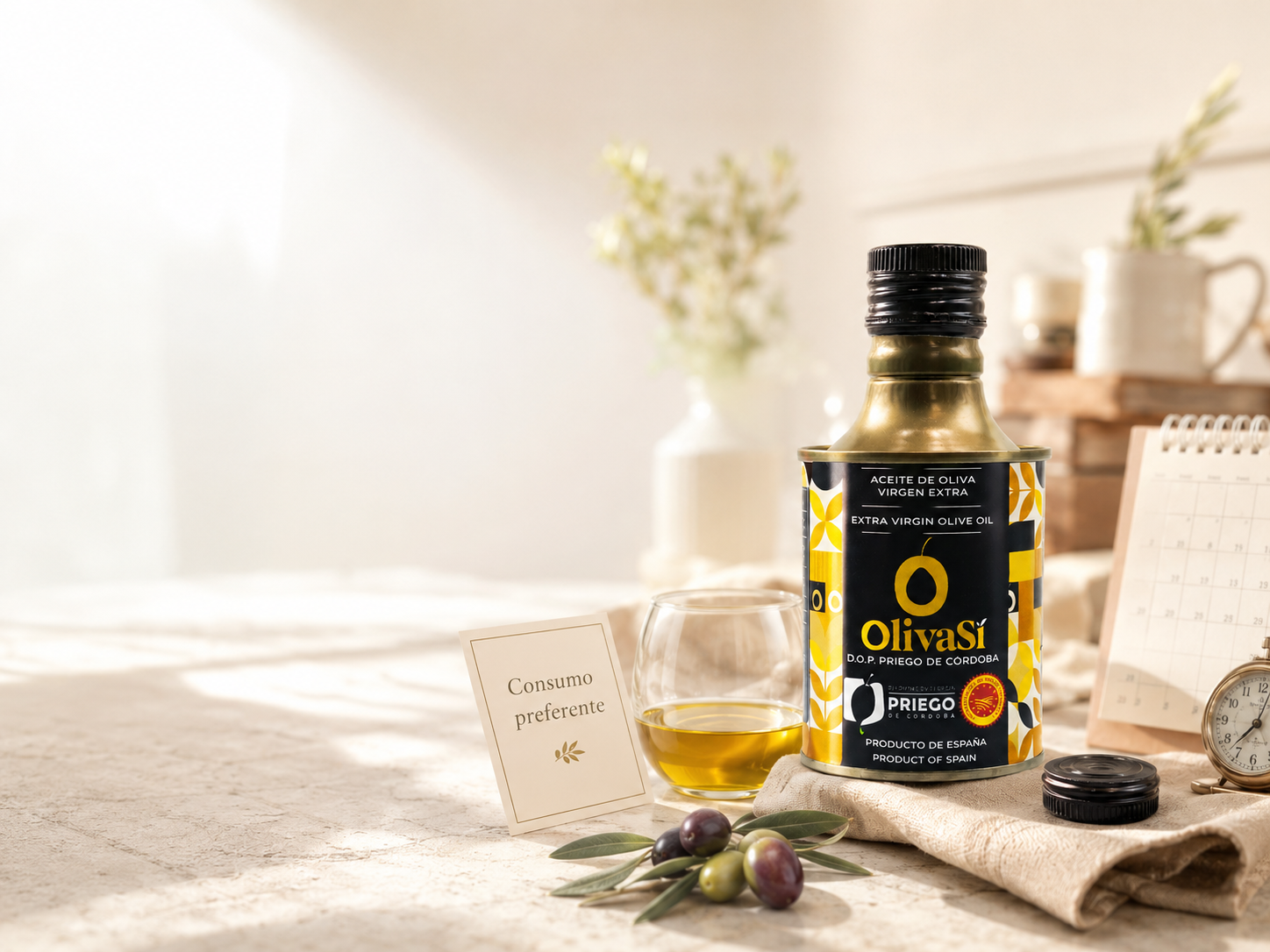
Quick answer: does EVOO expire or only have a best-before date?
For EVOO, you usually see "best before." This means that up to that date, the oil should best maintain its aroma, flavor, and freshness.
After that date, it may still be suitable for consumption, but it's more likely to have lost intensity or become more "flat." It's not like yogurt: the main issue here is sensory quality, not immediate "expiration."
Best-before vs. expiration: the important difference
-
Best before: the product can still be consumed, but quality is not guaranteed to be the same.
-
Expiration: after the date, it is not recommended to consume for safety reasons.
For oils, what matters is: how it was stored and how it smells/tastes.
Why EVOO loses quality over time
EVOO suffers primarily from oxidation. And it's accelerated by three enemies:
-
Light
-
Heat
-
Oxygen (air)
That's why an excellent EVOO can spoil faster in a hot/light kitchen than a "normal" one that's well-stored.
What changes when EVOO ages (even if it's "not bad")
Before becoming clearly rancid, it usually goes through phases:
-
The fruitiness fades (smells less like olive/grass/tomato).
-
The flavor becomes flatter.
-
The mouthfeel loses "spark" and persistence.
-
If it continues to degrade, the rancid defect appears.
Clear signs of rancidity (the ones that really matter)
At home, the most reliable indicators are nose + mouth:
-
Smell: reminiscent of old grease, stale nuts, "wax," or even varnish/solvent in pronounced cases.
-
Taste: unpleasant, dull finish, with a "stale oil" sensation.
If you notice these clearly, that oil is no longer enjoyable, and it's not worth trying to "mask" the defect.
Confusing signs that DO NOT mean it's bad
Some things may be alarming but aren't rancidity:
-
Cloudiness / haze: can be due to cold (it thickens/becomes cloudy). It returns to normal when warmed.
-
Sediment: in unfiltered oils or with natural particles. Not an automatic sign of being bad.
-
Color: not a reliable indicator (varies by variety, filtering, and ripening).
Rancidity is mainly detected by smell and taste.
Quick home test to check if it's good (30 seconds)
-
Pour a teaspoon into a small glass.
-
Cover the glass with your hand and warm it slightly (10-15 seconds).
-
Smell and taste.
If a fresh, pleasant aroma emerges → good.
If "old grease/varnish" appears → bad sign.
The 7 mistakes that most spoil EVOO at home
-
Storing it next to the stove/oven
-
Leaving it on a shelf with light or near a window
-
Keeping the container open while cooking
-
Using an oil cruet that doesn't close properly
-
Buying a format that's too large for your consumption and leaving it open for months
-
Transferring it to "pretty" clear containers (pure light + air)
-
Storing it where there are sudden temperature changes (very hot kitchen during the day)
How to store EVOO to make it last longer (without getting complicated)
Simple rule: dark + cool + well-sealed.
-
Location: pantry or cupboard, away from heat and light.
-
Seal: always close tightly (oxygen is the silent enemy).
-
Daily use: if you have a large format, refill a small cruet and keep the main container well-sealed and protected.
Temperature: what really helps (without obsessing)
-
A stable and cool temperature is best.
-
Avoid "peaks" (countertop near the stove).
-
Refrigerator: can be used if your home is very hot, but the oil may become cloudy/thicken. This is not bad in itself; it usually recovers when it returns to room temperature.
How long does EVOO last once opened?
There's no single figure, but there's a clear idea:
-
The longer it's open and the more it's "opened/closed," the more oxygen enters → the sooner it loses aroma.
-
If you use it a lot and store it well, it lasts better than if you open it infrequently but keep it near heat/light.
Practical advice: if you want it "at its best," don't leave it open indefinitely.
What size to buy according to your consumption (to avoid losing quality)
-
If you consume oil daily, a larger format may make sense.
-
If you use it rarely or only for raw dishes, a smaller format is better to finish it fresher.
This seems obvious, but it has the greatest impact on the actual quality that reaches your plate.
What to do if the best-before date has passed
-
If it smells and tastes good: use it without hesitation, especially for cooking.
-
If it's flat: save it for stews/sautéing/baking and keep a fresh EVOO for raw dishes.
-
If it smells or tastes rancid: it's best to discard it.
How to "make use" of EVOO that's no longer suitable for raw dishes
If it's not clearly rancid but has lost fruitiness:
-
Sautéing, stews, baking, stir-fries.
-
Avoid: toast, salads, dishes where oil is the star.
Frequently asked questions about EVOO expiration
Can I consume EVOO after the best-before date?
Yes, if the smell and taste are good. What may have decreased is the sensory quality.
Does cloudiness mean it's bad?
Not necessarily. It could be due to cold or being unfiltered. Rancidity is mainly detected by smell/taste.
Does EVOO "sting" and is that bad?
No. Pungency and bitterness can be normal in fresh EVOOs. What's bad is the rancid defect (old grease/varnish).
Which lasts longer: a large or small bottle?
Once opened, a small one usually lasts better, because less air enters over time.
Is it a good idea to always keep an oil cruet full?
Yes, but it's better if it's opaque or at least away from light, and closes well.
What's the worst place to store EVOO?
Countertop near the stove, in direct sunlight, or where it receives constant heat/light.
If you want to ensure your EVOO is at its best, do the glass test (hand + sniff) and store the oil like gold: dark, cool, and well-sealed.