
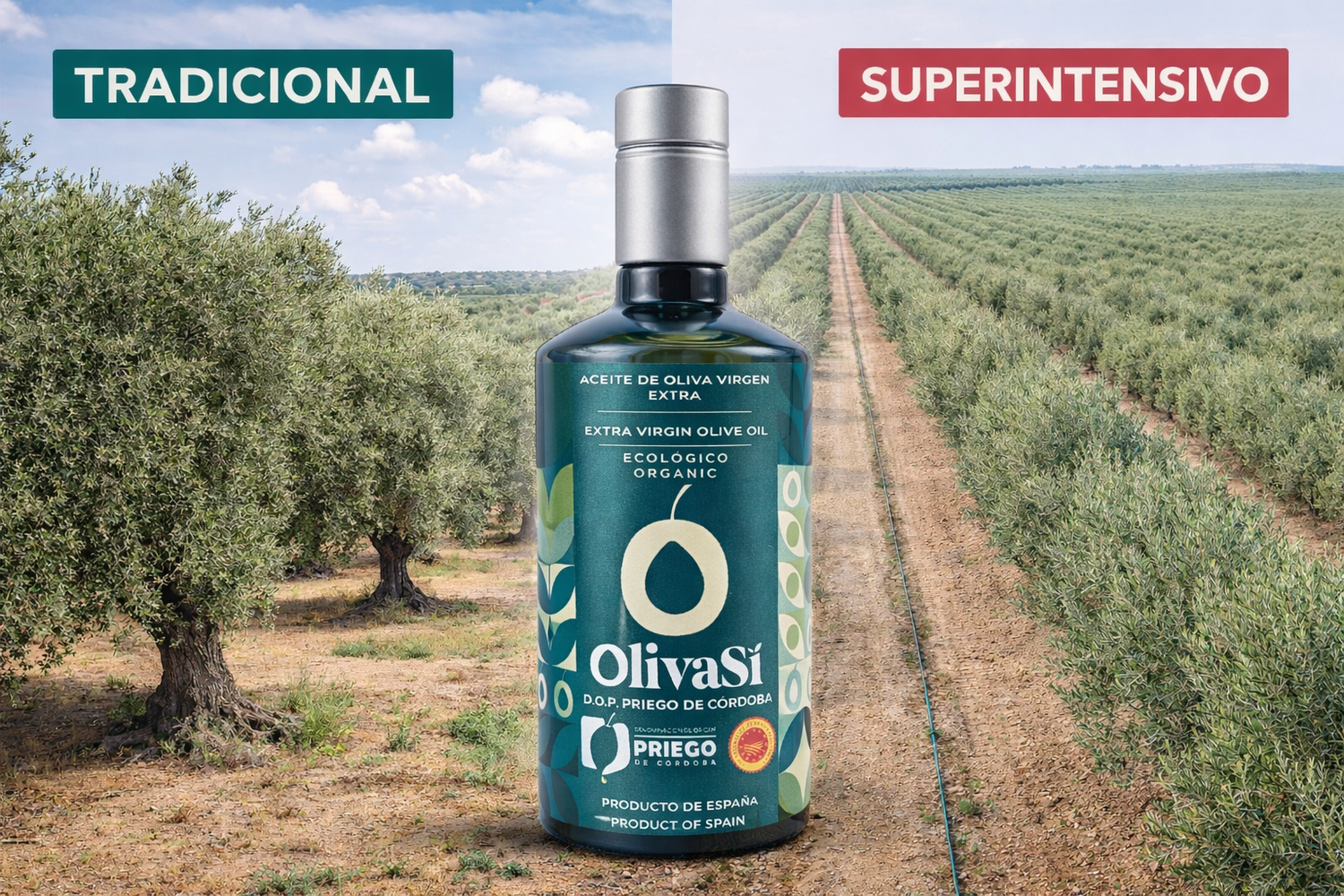
“Traditional vs. super-intensive olive groves: why you should care
When people talk about traditional versus super-intensive olive groves , they often only think about hectares and machinery. But if you're here, the important thing isn't the tractor: it's the extra virgin olive oil that ends up on your toast, in your salad, or in your kitchen.
At Oliva Sí we explain it simply: what each type of olive grove is, how it affects the flavor and quality of EVOO and what you are supporting every time you choose a bottle.
1. Traditional vs. super-intensive olive groves (explained simply)
Traditional olive grove
It's the traditional olive grove landscape:
-
Fewer trees per hectare.
-
Older, more spaced-out trees.
-
More manual labor and more time.
It is usually linked to family farms and villages where the olive tree is an integral part of life. Here it is easier to focus on early harvests and oils with a strong character.
Intensive olive grove
It's a middle ground:
-
More trees and neater rows.
-
Easier to use machinery.
If properly cared for, it can produce very high quality extra virgin olive oils , with slightly higher production.
Super-intensive olive grove (hedgerow)
Here the olive trees are planted very close together, forming a “green wall”:
-
Everything is designed so that a machine can collect quickly.
-
High volume and low costs per liter are sought.
It is usually intended for more standardized oils, designed for mass consumption, blends and products where price matters more than the personality of the oil.
2. How it influences EVOO: flavor, quality and price
Harvest time: liters or quality
In quality -oriented olive groves, the producer can afford to:
-
Harvest earlier (early harvest).
-
Extract fewer liters per kilo of olives.
-
To obtain a more aromatic, intense and polyphenol-rich EVOO.
In highly productive models, such as many super-intensive ones, the balance tends to tip more towards:
-
wait until the olive has a higher yield,
-
prioritizing the quantity of oil over the character of the EVOO.
That kind of decision is what you notice later in the bottle.
In the cup and on the plate: what you perceive
An extra virgin olive oil from well-maintained olive groves , with good harvesting, is usually:
-
More fragrant (grass, tomato, green fruit, almond…).
-
With balanced bitterness and spiciness , they feel lively yet pleasant.
-
With a flavor that will be remembered.
A more industrial oil is usually:
-
Correct, but flat .
-
With little aroma.
-
Without much personality.
The difference isn't theoretical: you notice it in a piece of toast, in a salad, or in a stew.
Price: why a good EVOO can't cost "two cents"
A well-managed traditional or intensive olive grove involves:
-
More labor.
-
More control over time.
-
More care in the field and in the olive mill.
This is reflected in the final cost per liter . An extra virgin olive oil that clearly states its origin, variety, and harvesting method cannot compete on price with an anonymous, mass-produced oil. They're not playing in the same league.
3. What are you supporting with each bottle?
When you compare traditional olive groves vs super-intensive ones , you're not just choosing about flavor:
-
With an EVOO from traditional or carefully tended olive groves you support
-
landscape ,
-
living villages ,
-
more respectful farming models.
-
-
With an ultra-cheap oil, you're probably supporting
-
a more industrial model,
-
large volumes and little information about the origin.
-
It's not about demonizing super-intensive agriculture, but about being clear that your purchase has an impact beyond your kitchen.
4. How to choose the right EVOO (and where Oliva Sí comes in)
Quick tips on the label and on the web
If you want a good extra virgin olive oil, look at:
-
Does it indicate variety and region ?
-
Are you referring to an early harvest or a specific season?
-
Does it tell you anything about the type of olive grove or the work behind the oil?
The clearer the description, the better. If the oil description doesn't say anything at all, it's usually a sign of a more industrial product.
What we stand for in Oliva Sí
At Oliva Sí we are committed to a clear model:
-
Quality over liters.
-
Pay attention to the condition of the olive and the time of harvest.
-
Respect for the origin and landscape from which our oil comes.
We want you to feel, when you open a bottle, that this EVOO is made to be enjoyed and to take care of yourself , not just for "frying and that's it".
Quick question we get asked a lot
Is a traditional olive oil always better?
Not always, but it does help .
A poorly managed traditional olive grove can produce weak oils, while a well-managed intensive olive grove can yield brilliant extra virgin olive oils. The key lies not only in the type of olive grove, but also in the philosophy of those behind it : the decisions made in the field and at the mill.
Conclusion
Talking about traditional vs super-intensive olive groves is talking about something very simple:
What type of oil do you want on your table and which model do you want to support with your purchase?
If you like an extra virgin olive oil with character, origin, and values, look for producers who can tell you all about it clearly. And, if you want to experience it in your own kitchen, at Oliva Sí we'd be delighted to make it easy for you right there in the bottle 🫒✨.