

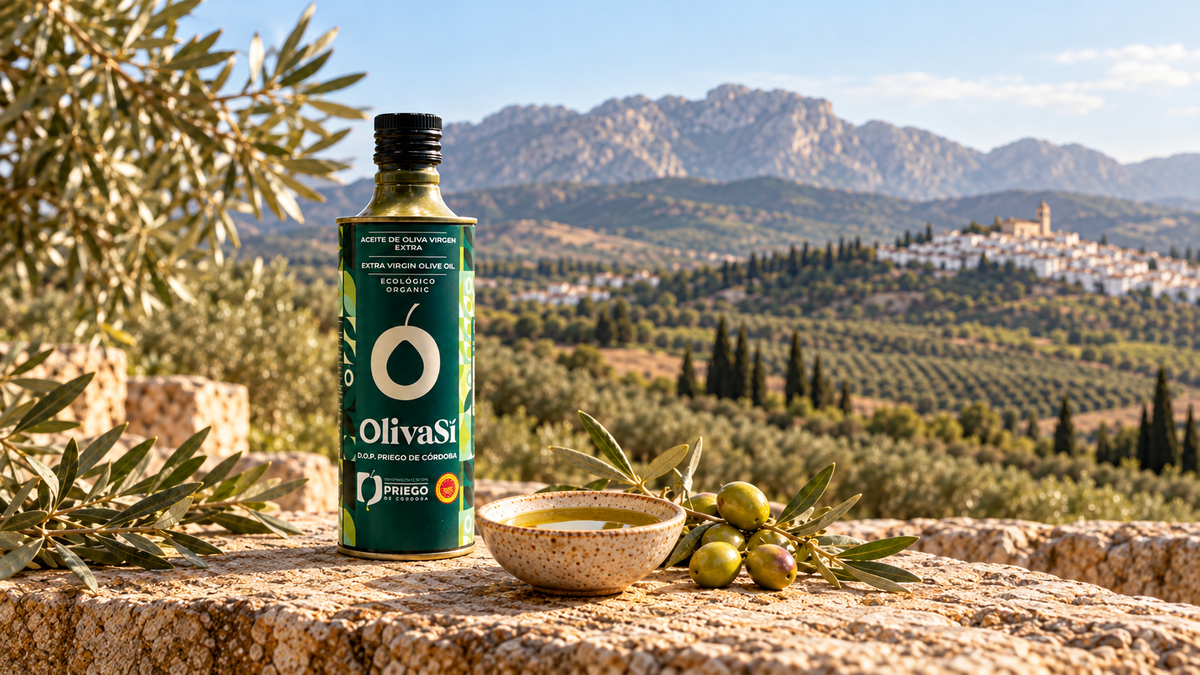
Spain has more than thirty designations of origin for olive oil, and they almost always appear as a list, as if they were interchangeable. They are not. Each one covers specific varieties, in a specific territory, with its own requirements.
This is ours. We are going to tell the whole story: what territory it covers, which olives, what it tastes like, what the seal really checks, what it does not guarantee and how to verify on a label that an oil carries it.
What the PDO Priego de Córdoba is
It is a Protected Designation of Origin that covers only extra virgin olive oil produced and packed in four municipalities in the south-east of the province of Córdoba, made from three specific olive varieties and verified batch by batch by a regulatory council.
In one sentence: it guarantees where the oil comes from, which olives it is made from and that someone independent of the producer has checked it.
Where it is and why the place matters
The protected area covers four municipalities: Priego de Córdoba, Carcabuey, Almedinilla and Fuente-Tójar. Nothing more. An oil made with olives from outside those four municipalities cannot carry the seal, however good it is.
This is mountain country, right in the Sierras Subbéticas Natural Park. Here lies the Sierra de la Horconera, with La Tiñosa, the highest peak in the province. The towns themselves sit between 550 and 700 metres, and much of the olive grove climbs higher still. Priego and Carcabuey are officially recognised as mountain areas.
That altitude is not a brochure flourish. Mountain olive groves have cooler nights, a wider temperature swing between day and night and slower ripening, and the olives reach the mill with a greater aromatic load. It also means slopes, lower yields per hectare and a harvest that is far more expensive than on flat land. The quality of this area is paid for in work.
Three varieties, and one found almost only here
The specification covers three: Picuda, Hojiblanca and Picual.
The one that defines the character of the area is Picuda, also called Picudo. It is the native variety, rarely grown outside this area: Picuda is one of the characteristic varieties of the area. It gives oils that are sweet on the palate at first and complex on the nose, with hints of ripe fruit and tomato, and less aggressive in the mouth than a pure Picual.
Hojiblanca adds freshness and herbaceous notes. Picual brings structure, bitterness and stability over time.
That is why blending matters so much here: it is not a blend of convenience, but the traditional way of balancing three characters that complement each other. If you want the detail on each one, we cover it in Hojiblanca vs Picual vs Picuda.
What it tastes like: the types recognised by the specification
This is almost never explained, and it is one of the most useful things to know when choosing. The specification does not describe “one” oil: it defines several types according to the predominant variety, each with its own sensory profile.
The type made with more than 50% Picuda is described as fruity, aromatic, pleasant and sweet on the palate at first. The other protected types range from a fruity, fresh profile, also sweet at first, to a fruity, aromatic one with light to medium bitterness.
Translated to the table:
| If the oil is… | It goes especially well with… |
|---|---|
| Sweet at first and aromatic | White fish, steamed vegetables, baking, breakfasts, seasonal tomatoes |
| Fresh and herbaceous | Salads, gazpacho and salmorejo, fresh cheeses, seafood |
| With pronounced bitterness and pepperiness | Meat, pulses, bread with oil, stews, smoked foods |
If you want to learn to tell them apart yourself, we have a guide on how to taste an extra virgin olive oil step by step.
What the seal really checks
A PDO is not a pretty sticker: it is a product specification with measurable parameters and a regulatory council that checks them. In the case of Priego de Córdoba:
- Origin: olives from registered groves within the four municipalities.
- Varieties: only the three authorised ones.
- Category: extra virgin only. There is no “virgin” olive oil with the PDO Priego.
- Maximum acidity: 0.5°. This figure deserves a pause.
- Mechanical extraction, preserving the flavour and aroma of the fruit, without altering the oil.
- Traceability: olives separated by area and variety on arrival at the mill.
- Batch-by-batch verification: laboratory analysis and a tasting panel before an oil can be certified.
On acidity: European rules allow an oil to be called extra virgin up to 0.8°. This PDO’s specification lowers that limit to 0.5°. In other words, there are perfectly legal extra virgin oils that could not be certified here. That margin is, in a single figure, the difference between meeting the standard and holding yourself above it. If you are not sure what acidity means, we explain it in this article.
What a PDO does NOT guarantee
It is worth saying, even though it is ours: the seal does not automatically make an oil the best on the shelf.
It guarantees origin, varieties, process and a verified minimum of quality. It does not guarantee that the oil is better than an excellent extra virgin from an estate without a designation. Nor does it say anything about how the oil has been handled afterwards: a certified oil that has spent two years in a sunny shop window will be worse than a recent one without a seal.
Nor does it mean organic: they are two separate, independent certifications. What the PDO does do, and it is no small thing, is remove uncertainty.
How to check that an oil carries the PDO
- The name “Priego de Córdoba” must appear explicitly on the label: the specification makes it mandatory. It is usually accompanied by the red European Protected Designation of Origin logo.
- The numbered back label from the regulatory council, which identifies the certified batch.
- Be wary of vague wording. “Made in Priego”, “from the Córdoba mountains” or “Subbética style” are not the designation.
- Check the list of certified brands, which the regulatory council publishes. Anyone can consult it.
More tips for reading a label without getting it wrong in extra virgin, virgin and olive oil: which to buy.
Is it worth paying more for an oil with this PDO?
It depends on what for. To fry a batch of croquettes, no: the flavour is lost there. For everything eaten raw —a slice of toast, a tomato, freshly cooked fish, a salmorejo— you notice the difference from the first spoonful.
And the extra cost has concrete causes, not marketing ones: mountain groves with lower yields, harvesting on slopes, a stricter acidity limit and external batch-by-batch control.
An area that has been doing this for a long time
Olive growing is not a recent trend here. A 1747 survey commissioned by the Marquis of Priego already recorded more than 20,000 arrobas of oil produced in the area, and at the beginning of the 20th century there were more than forty mills in the municipality of Priego alone. Today olive groves cover practically all of the area’s farmland.
That explains a part of the quality that does not show up in any analysis: generations of people who know when the olives need to be picked and how long they can wait before being milled.
You can visit
The four municipalities are linked by an olive oil tourism route, with mills open to visitors, guided tastings and a historic centre, that of Priego, which is among the most beautiful of the Andalusian Baroque. If you are interested in olive oil, seeing a mill in the middle of the harvest season —between November and January— completely changes the way you look at a bottle.
Taste PDO Priego de Córdoba at home
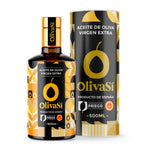
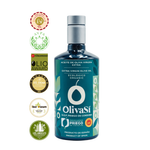
Our Golden Edition extra virgin olive oil is a blend of Hojiblanca, Picuda and Picual certified under the PDO Priego de Córdoba.
See Golden EditionFrequently asked questions
Which municipalities are included in the PDO Priego de Córdoba?
Four: Priego de Córdoba, Carcabuey, Almedinilla and Fuente-Tójar, in the south-east of the province of Córdoba.
Which varieties does it cover?
Picuda, Hojiblanca and Picual. Picuda is the native variety and the one that most defines the area’s profile.
Can an oil with the PDO be anything other than extra virgin?
No. The specification only covers extra virgin, with an acidity limit of 0.5°, stricter than the 0.8° allowed by the general rules.
Is an oil with a PDO organic?
Not necessarily. They are independent certifications: the PDO certifies origin, varieties and quality; the organic certification, the farming method. An oil can have one, the other, both or neither.
What does Priego de Córdoba oil taste like?
The dominant profile, shaped by Picuda, is fruity and aromatic, sweet on the palate at first, with hints of ripe fruit. Depending on the predominant variety, the specification also recognises fresher profiles and others with light to medium bitterness.
How is it different from the PDO Baena?
They are neighbouring but distinct areas, each with its own municipalities and protected varieties. They share Picuda, which in the Baena area is also known as Carrasqueña.
Why does it cost more?
Mountain groves with lower yields, more expensive harvesting on slopes, a stricter acidity limit and external batch-by-batch control.
Where these facts come from
The area, varieties, oil types and parameters come from the official product specification of the PDO Priego de Córdoba, published by Spain’s Ministry of Agriculture, Fisheries and Food and by the Regional Government of Andalusia. The 0.8° limit for extra virgin comes from the European marketing standards for olive oil.
At Oliva Sí we produce under this designation. You can see our oils in Golden and Organic, or call us on +34 634 36 47 23 if you would like help choosing.


